
Built to Breathe: How an 18-Meter Ceiling and Solar Bifacial Roof Drive Passive Cooling at EVCC™ Pedas RSA
Updated: Jun 22, 2025
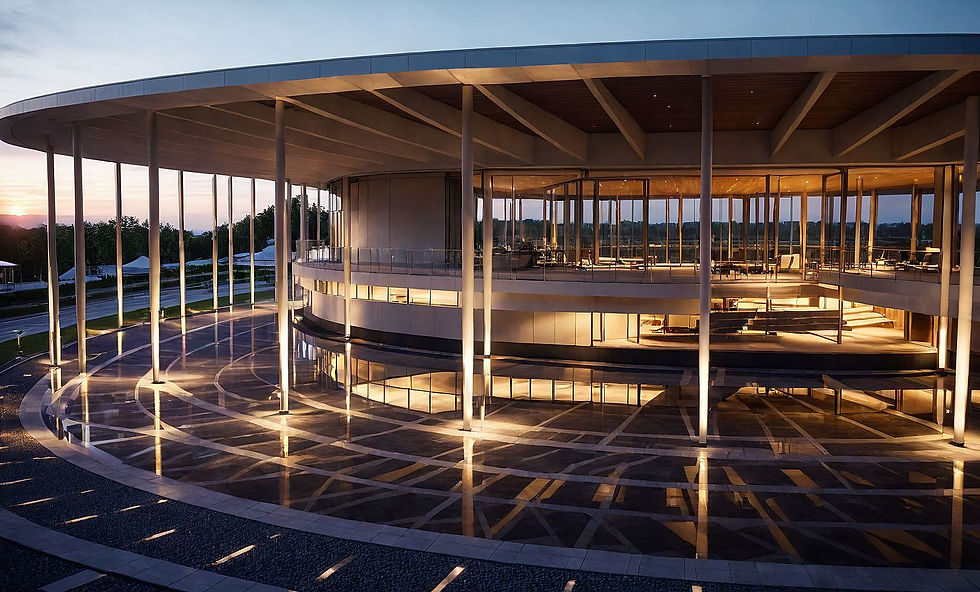
At EVCC™ Pedas RSA, the roof does more than cover — it generates power, channels light, and enables the building to breathe naturally.
Incorporating a soaring 18-meter-high internal ceiling and a curved bifacial solar panel roof, the architecture sets a new benchmark for sustainable rest stop design in Malaysia.
The combination of vertical volume and solar-integrated structure is not just for show — it’s a deliberate strategy to reduce energy dependency, enhance ventilation, and elevate user comfort in a tropical climate.
1. Vertical Strategy: Why 18 Meters Makes a Difference
Conventional buildings often struggle with heat build-up due to limited vertical air space. At EVCC™, the 18-meter ceiling creates a natural chimney effect, enabling warm air to rise well above occupied zones.
This vertical thermal gradient powers the stack effect — where hot air is drawn upward and expelled through concealed upper-level louvered vents, while cooler air enters from lower-level openings.
This approach enables:
Continuous air renewal without active HVAC
Lower indoor temperatures at the pedestrian level
Reduced mechanical cooling demand, especially in semi-open areas
The result? A more breathable, comfortable environment — even during peak heat and crowding.
2. Cross-Wind Coordination: Layout That Catches the Breeze
The site’s elliptical masterplan and open axial circulation are not aesthetic choices alone. They're aligned with Malaysia’s prevailing wind patterns, intentionally allowing natural cross-flow ventilation. Air enters from the RSA’s ingress zones, travels laterally through open walkways and public spaces, and exits vertically through the high ceiling.
This creates a hybrid ventilation system — horizontal wind flow meets vertical heat displacement — amplifying cooling without turning on a single fan.
3. Bifacial Solar Roof: Power, Shade, and Light in One Structure
Above the breathable interior, a bifacial solar roof system spans the structure. Unlike traditional rooftop solar arrays, this integrated glass photovoltaic canopy allows for:
Dual-surface solar collection (top and underside reflection)
Filtered natural daylight, creating soft interior illumination
Thermal shading, significantly reducing direct solar heat gain
Its curved geometry follows the building’s elliptical form, maintaining architectural cohesion while contributing to onsite renewable energy production for lighting, EV chargers, and ventilation controls.
The use of Building-Integrated Photovoltaics (BIPV) ensures the roof isn’t just a covering — it’s a multi-functional climate system that contributes to energy savings, spatial experience, and green compliance.
4. Green by Design, Not Just by Label
The combined impact of the high ceiling and bifacial solar roof positions EVCC™ Pedas RSA to meet Platinum-level green building targets, contributing toward:
Indoor Environmental Quality (IEQ)
Energy Use Intensity (EUI) Reduction
Daylighting credits under GreenRE systems
Where Infrastructure Breathes with the Environment
EVCC™ Pedas RSA’s design philosophy goes beyond aesthetics or engineering. It’s about building for Malaysia’s real-world climate, user behaviors, and future mobility needs. By leveraging vertical volume, cross-wind orientation, and solar-smart materials, EVCC™ demonstrates how a rest area can do more than stop the journey — it can enhance it.
With its 18-meter breathable core and energy-generating solar skin, this RSA doesn’t just serve travelers. It leads them into the future of sustainable expressway infrastructure.


Comments